
Overcoming Organizational Resistance: A Strategic Protocol for Managing the Behavioral and Cultural Shift of AI Integration.
- Executive Summary
- 1️⃣ The Core Problem: Technology is Deployed, Behavior is Not
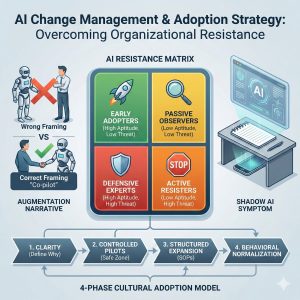
- 2️⃣ The AI Resistance Matrix (Behavioral 2×2 Model)
- 🟢 Early Adopters (Low Threat / High Aptitude)
- 🟡 Passive Observers (Low Threat / Low Aptitude)
- 🔴 Defensive Experts (High Threat / High Aptitude)
- ⛔ Active Resisters (High Threat / Low Aptitude)
- 3️⃣ The “Augmentation Narrative” Principle
- 4️⃣ The 4-Phase Cultural Adoption Model
- Phase 1: Clarity (Define the “Why”)
- Phase 2: Controlled Pilots (The “Safe Zone”)
- Phase 3: Structured Expansion (Standardization)
- Phase 4: Behavioral Normalization
- 5️⃣ Shadow AI: A Symptom of Cultural Friction
- 6️⃣ The AI Adoption KPI Dashboard
- 7️⃣ Practical 90-Day Cultural Rollout Plan
- 8️⃣ Executive Leadership Protocol
- FAQ
Executive Summary
AI implementation rarely fails because of technology. It fails because of human resistance.
When organizations deploy Generative AI, they often treat it as a standard software update—buying licenses, holding a workshop, and expecting immediate productivity gains. Instead, they encounter employee fear, silent non-compliance (“shadow sabotage”), and stagnant usage rates.
Generative AI fundamentally alters power distribution, workflow structures, and skill hierarchies within a company. Therefore, AI adoption is not an IT project; it is a behavioral transition.
This article outlines the AI Resistance Matrix, a structured 4-Phase Adoption Model, and a targeted 90-day cultural rollout plan to help leaders transform fear into measurable, standardized productivity.
1️⃣ The Core Problem: Technology is Deployed, Behavior is Not
Most organizations announce their AI initiatives with an emphasis on automation and speed. To leadership, this sounds like efficiency. To employees, it sounds like redundancy.
When AI is dropped into existing workflows without redesigning the incentives or addressing the psychological impact, three things happen:
- The “Blank Page” Paralysis: Employees don’t know what to prompt and quickly abandon the tool.
- Defensive Sabotage: Highly skilled workers dismiss AI outputs as “inferior” to protect their domain authority.
- Shadow AI: Enthusiastic employees use unapproved, external AI tools because official policies are too restrictive or confusing.
To scale AI, leadership must manage the psychology of adoption as rigorously as the technology stack.
2️⃣ The AI Resistance Matrix (Behavioral 2×2 Model)
To effectively drive adoption, leadership must accurately identify and manage different types of employee resistance.
Axis Y: Perceived Threat Level (Fear of replacement or loss of status)
Axis X: AI Aptitude / Skill Level (Ability to use and understand AI tools)
| Threat / Aptitude | Low AI Aptitude | High AI Aptitude |
|---|---|---|
| Low Threat | 🟡 Passive Observers | 🟢 Early Adopters |
| High Threat | ⛔ Active Resisters | 🔴 Defensive Experts |
🟢 Early Adopters (Low Threat / High Aptitude)
- Profile: Curious, highly experimental, already using AI in their personal lives.
- Action: Empower them as Internal AI Champions. Task them with building prompt libraries and mentoring others.
🟡 Passive Observers (Low Threat / Low Aptitude)
- Profile: Neutral but hesitant. They aren’t afraid of AI, but they don’t want to break anything or look foolish trying to learn it.
- Action: Demonstrate immediate, personal ROI. Show them how AI eliminates their most boring, repetitive tasks.
🔴 Defensive Experts (High Threat / High Aptitude)
- Profile: Senior specialists (lawyers, senior engineers, lead copywriters) who feel their hard-earned expertise is being commoditized. They will actively find flaws in AI outputs to prove it is useless.
- Action: Appoint them as “Red Teamers.” Give them the authority to audit AI outputs and define the Fiduciary Boundaries. Shift their role from creators to editors/verifiers.
⛔ Active Resisters (High Threat / Low Aptitude)
- Profile: Driven by fear of job loss. Will actively avoid using the tools and may spread negative sentiment.
- Action: Address the “Augmentation Narrative” directly. Tie basic AI literacy to performance KPIs so avoidance is no longer an option.
3️⃣ The “Augmentation Narrative” Principle
Language shapes resistance. If leadership frames AI as a tool to “automate 40% of tasks,” the workforce will hear “eliminate 40% of jobs.”
- ❌ Wrong Framing: “We are deploying AI to cut reporting time in half and reduce operational costs.”
- ✅ Correct Framing: “We are deploying AI to eliminate low-value friction, allowing you to focus on high-leverage, strategic work that machines cannot do.”
Never frame AI as a replacement. Frame it as a mandatory co-pilot that protects the company’s competitive edge.
4️⃣ The 4-Phase Cultural Adoption Model
Phase 1: Clarity (Define the “Why”)
Before rolling out licenses, leadership must define the exact purpose of AI in the organization. Ambiguity creates fear. Clearly communicate what AI will do (e.g., draft emails, summarize logs) and what it will not do (e.g., replace headcount, make final approvals).
Phase 2: Controlled Pilots (The “Safe Zone”)
Do not launch enterprise-wide on day one. Select volunteer teams to run pilots in the Safe Zone (low-risk, routine tasks). Measure the time saved and error rates. Build internal case studies based on actual colleagues, not abstract tech demos.
Phase 3: Structured Expansion (Standardization)
Transition AI from an “optional novelty” to a Standard Operating Procedure (SOP). This requires establishing a centralized Prompt Library where employees can access pre-tested, high-quality prompts specifically designed for their daily tasks.
Phase 4: Behavioral Normalization
AI adoption is culturally normalized only when:
- It is visibly used by the C-Suite in daily operations.
- AI efficiency is assumed in project timelines.
- “AI Prompting” is a required skill in job descriptions and performance reviews.
5️⃣ Shadow AI: A Symptom of Cultural Friction
In the AI Governance Model, Shadow AI is treated as a security risk. In Change Management, Shadow AI is viewed as a cultural symptom.
If employees are secretly using ChatGPT or Claude on their personal devices for work tasks, it means two things:
- They recognize the value of AI and want to be productive.
- Official company tools are either non-existent, too difficult to access, or blocked without viable alternatives.
Solution: Suppression creates underground adoption. You cannot ban AI; you can only provide a safer, sanctioned, and superior internal alternative.
6️⃣ The AI Adoption KPI Dashboard
To ensure the rollout is working, organizations must measure behavior, not just rhetoric. Track these metrics:
| Key Performance Indicator | Description / Purpose |
|---|---|
| Active Usage Rate | % of provisioned licenses used weekly. (Identifies adoption stagnation). |
| SOP Integration % | Number of core workflows that explicitly require AI assistance in their documentation. |
| Verification Tax | Time spent correcting AI errors vs. time saved by generating the draft. |
| Prompt Library Utilization | Frequency of access to the corporate prompt repository. |
7️⃣ Practical 90-Day Cultural Rollout Plan
Note: This timeline runs concurrently with your IT/Governance implementation.
- Weeks 1–3: Mapping & Champions. Identify your Early Adopters to act as internal ambassadors. Map out 3-5 high-friction, low-risk tasks suitable for immediate AI intervention.
- Weeks 4–6: Safe Zone Pilots. Launch AI access to a small, controlled group. Focus on quick, undeniable wins (e.g., meeting summaries, data formatting). Document the ROI.
- Weeks 7–10: SOPs & Prompt Engineering. Open access to broader departments. Do not just train them on “how the AI works”—train them on specific, approved prompts for their exact jobs.
- Weeks 11–13: KPI Integration. Embed AI usage into performance reviews. Share success stories in company-wide meetings. Have executives visibly present AI-generated data.
8️⃣ Executive Leadership Protocol
AI adoption collapses when leadership sends mixed signals. If executives demand AI efficiency but do not use the tools themselves, the workforce will treat it as a passing management fad.
Leaders must:
✔ Visibly use AI to generate meeting agendas or draft internal memos.
✔ Openly discuss the limitations and “hallucinations” they encounter (vulnerability builds trust).
✔ Reward employees who find new ways to automate routine tasks.
FAQ
Why do AI projects fail after initial enthusiasm?
Because organizations underestimate behavioral resistance and overestimate technical readiness. Without redesigned workflows and updated KPIs, employees revert to their old habits.
Should AI adoption be mandatory?
For standard, routine workflows (Safe Zone)—yes. Treating AI as an “optional tool” ensures it will only be used by the 10% of Early Adopters, preventing scalable ROI.
How do you reduce employee fear of replacement?
By setting strict Fiduciary Boundaries. When leadership explicitly defines what decisions must remain human, employees feel secure in their ultimate value to the company.
Last updated: 2026